 |
| Credit : NASA, ESA, CSA, STScI, Thomas Thomopoulos |
Wednesday, August 3, 2022
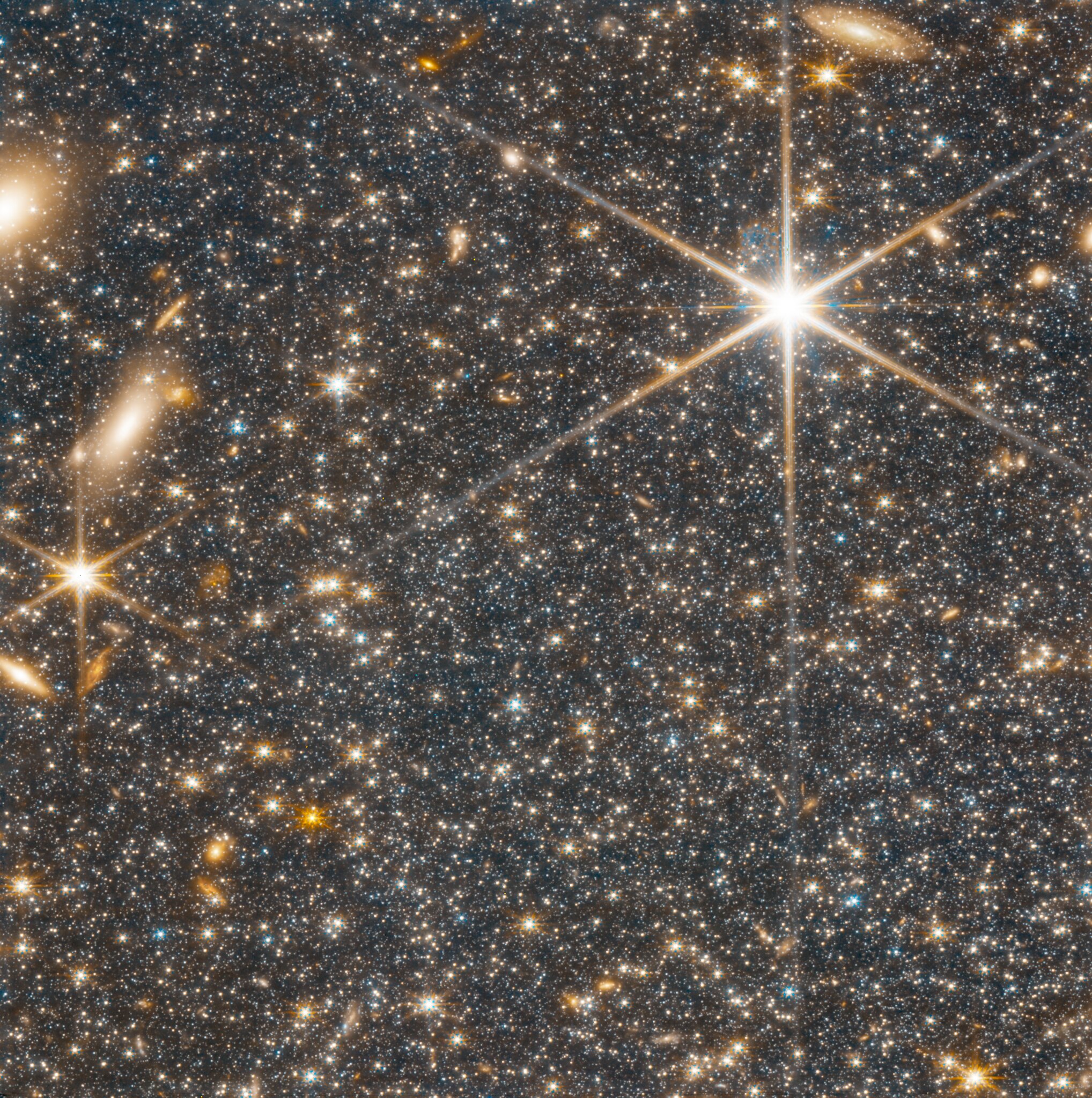
WLM - Outskirts of Wolf–Lundmark–Melotte
 |
| Credit : NASA, ESA, CSA, STScI, HiggsPhoton Sh |
 |
| Credit : NASA, ESA, CSA, STScI, HiggsPhoton Sh |
 |
| Credit : NASA, ESA, CSA, STScI, HiggsPhoton Sh |
Tuesday, August 2, 2022
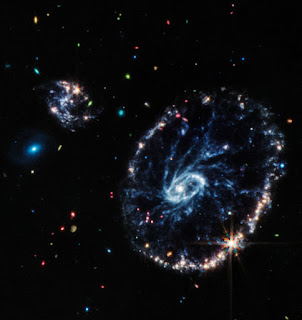
ESO 350-40, PGC 2248, AM0035-335 - Cartwheel Galaxy
.tif "ESO 350-40, PGC 2248, AM0035-335 - Cartwheel Galaxy (NIRCam and MIRI Composite Image) - A large galaxy on the right, with two much smaller companion galaxies to the left at 10 o’clock and 9 o’clock. The large galaxy resembles a speckled wheel, with an oval outer ring and a small, off-center inner ring. The outer ring contains pink plumes like wheel spokes, with dusty blue regions in between. The pink areas are silicate dust, while the blue areas are pockets of young stars and hydrocarbon dust. The inner ring is smoother, filled in with a more uniform pale pink. This smaller ring is interwoven with thin, orange-pink threads. On the galaxy's right edge, a bright white star with 8 diffraction spikes shines. The two companion galaxies to the left, one above the other, are about the same size and both spiral galaxies. The galaxy above is a reverse S shape but similar in coloring and texture as the large ring galaxy. The galaxy below is smoother and largely white, with a blue tinge.") |
| Credits: NASA, ESA, CSA, and STScI, Webb ERO Production Team |
 |
| Credits: NASA, ESA, CSA, STScI, Webb ERO Production Team |
 |
| Credits: NASA, ESA, CSA, STScI, Webb ERO Production Team |
 |
| Hubble visible light → JWST infrared |
| Manual slider comparing the Cartwheel Galaxy in near- and mid-infrared wavelengths through the eyes of Webb's NIRCam and MIRI instruments. |
WHAT A DELICIOUS SPACE DONUT!!! JWST just released their new image of the Cartwheel galaxy and I cannot get over how absolutely magical MIRI is! This telescope is showing us space in a whole new light!! (pun so very much intended) pic.twitter.com/ZEshtYXUo8
— Rebecca Larson (@SaturnsWings) August 2, 2022
| Credit |
Monday, August 1, 2022
IC 1623, Arp 236, VV 114
 |
| Credit : NASA, ESA, CSA, STScI, HiggsPhoton Sh |
 |
| Credit : NASA, ESA, CSA, STScI, John Bozeman |
 |
| Credit : NASA, ESA, CSA, STScI, Dr. Lee Armus (PI), Kevin Gill |
 |
| Credit : NASA, ESA, CSA, STScI, R. Colombari |
Friday, July 29, 2022
Jupiter
 |
| Credit : NASA, ESA, CSA, STScI, Lucca Schwingel Viola |
 |
| Credit: NASA, ESA, CSA, STScI, Jupiter ERS Team, Ricardo Hueso (UPV/EHU), Judy Schmidt |
 |
| Credit: NASA, ESA, CSA, STScI, Jupiter ERS Team, Ricardo Hueso (UPV/EHU), Judy Schmidt |
Thursday, July 28, 2022

Wednesday, July 27, 2022

Tuesday, July 26, 2022
NGC 7496 - Barred Spiral Galaxy
 |
| Credit: NASA, ESA, CSA, STScI, Judy Schmidt |
 |
| Credit: NASA, ESA, CSA, STScI, Judy Schmidt |
 |
 |
| Credit: NASA, ESA, CSA, STScI, Dong Liang |
 |
| Credit: Dr. Janice Lee (@janiceleeastro) |
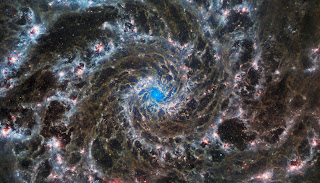
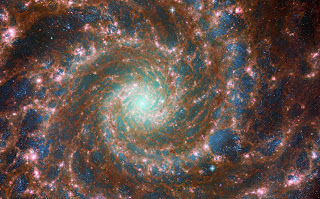
M74 (NGC 628) - The Phantom Galaxy
 |
| Credit: NASA, ESA, CSA, STScI, APOD, Robert Eder |
 |
| Credit: NASA, ESA, CSA, STScI, Judy Schmidt |
 |
| Credit: NASA, ESA, CSA, STScI, Gabriel Brammer (Cosmic Dawn Center, Niels Bohr Institute, University of Copenhagen); Raw data, Janice Lee et al. and the PHANGS-JWST collaboration. |
 |
| Credit: NASA, ESA, CSA, STScI, Thomas Thomopoulos |
 |
| Credit: ESA/Webb, NASA & CSA, J. Lee and the PHANGS-JWST Team. Acknowledgement: J. Schmidt |
 |
| Credit: ESA/Webb, NASA & CSA, J. Lee and the PHANGS-JWST Team; ESA/Hubble & NASA, R. Chandar. Acknowledgement: J. Schmidt |
| M74 - Comparing Hubble, NIRCam and MIRISci |
| Hubble and Webb Showcase M74 |
Monday, July 25, 2022
.tif "Cosmic Cliffs in the Carina Nebula (NIRCam Image) - The image is divided horizontally by an undulating line between a cloudscape forming a nebula along the bottom portion and a comparatively clear upper portion. Speckled across both portions is a starfield, showing innumerable stars of many sizes. The smallest of these are small, distant, and faint points of light. The largest of these appear larger, closer, brighter, and more fully resolved with 8-point diffraction spikes. The upper portion of the image is blueish, and has wispy translucent cloud-like streaks rising from the nebula below. The orangish cloudy formation in the bottom half varies in density and ranges from translucent to opaque. The stars vary in color, the majority of which have a blue or orange hue. The cloud-like structure of the nebula contains ridges, peaks, and valleys – an appearance very similar to a mountain range. Three long diffraction spikes from the top right edge of the image suggest the presence of a large star just out of view.")
.tif "NGC 3324 - A composite image of the Cosmic Cliffs in the Carina Nebula, created with the Webb telescope’s NIRCam and MIRI instruments. Pinkish brown clouds of gas and dust dominate the foreground of the image, glittering with young stars. Behind the glowing, mountainous clouds, the sky appears navy blue, with shining stars and galaxies.")
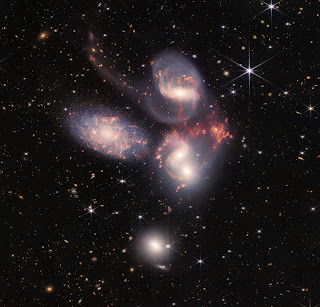
NGC 7317, NGC 7318A, NGC 7318B, NGC 7319, and NGC 7320 - Stephan's Quintet aka Hickson Compact Group 92 (HCG 92)
 |
| Credits: NASA, ESA, CSA, and STScI |
.tif "MIRI Image of NGC 7317, NGC 7318A, NGC 7318B, NGC 7319, and NGC 7320 - Stephan's Quintet aka Hickson Compact Group 92 (HCG 92), a collection of five galaxies, as seen by MIRI on the James Webb Space Telescope. The galaxies all glow in different colors, surrounded by lacy, glowing clouds of gas and dust. Four of the five are centered in the image. Three are visibly spiral galaxies, with tendrils extending out from their glowing centers. The galaxy farthest to the left appears slightly more clearly, with vibrant blue lacing surrounding the oval-shaped light of the galaxy. This is because the farthest left galaxy is not interacting with the other four; it’s actually far in the foreground from the others. The galaxies all appear against a field of sparkling stars and other, farther galaxies.") |
| Credits: NASA, ESA, CSA, and STScI |
 |
| Credits: NASA, ESA, CSA, STScI, Brian3114611 |
 |
| Credit: Juan Carlos Munoz (@astro_jcm) |
 |
| Credit: X-ray: NASA/CXC/SAO; IR (Spitzer): NASA/JPL-Caltech; IR (Webb): NASA/ESA/CSA/STScI |
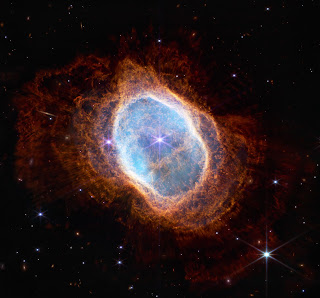
.tif "NGC 3132 - The Southern Ring Nebula - MIRI Image - A planetary nebula seen, by Webb’s MIRI, against the blackness of space, with points of starlight behind it. Plumes of glowing bright blue gas radiate out from the oval-shaped nebula. Two separate ovals of reddish pink gas appear stacked on top of each other, inside the lacy blue gas clouds. In the center of the nebula, two stars glow close to each other. One star looks more red, while the other appears more yellow.")
Subscribe to:
Posts (Atom)